English
 русский
 Français
 Español
 Deutsch
Engineering High Speed Folder Gluer Machines for Maximum Efficiency

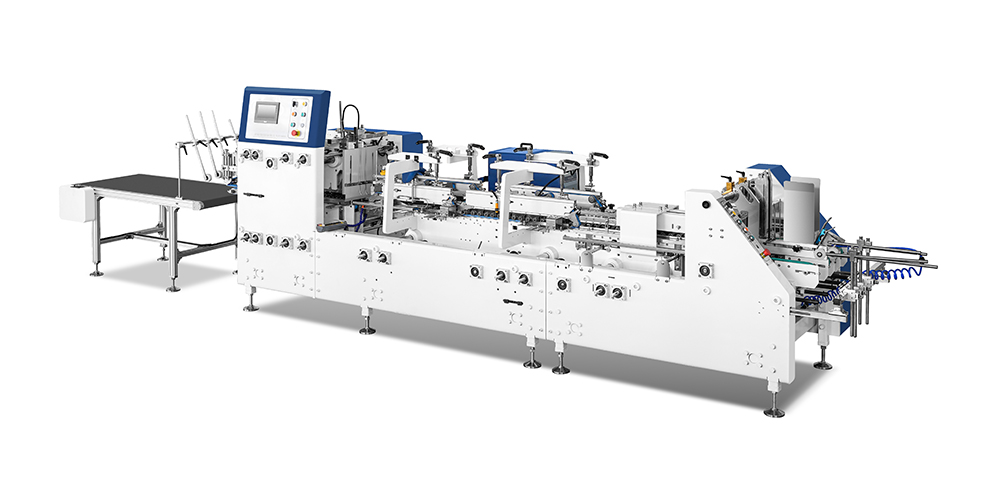
Making boxes quickly and well is very important in packaging. The High Speed Folder Gluer machine is a key piece of equipment in this process. It takes flat sheets of printed card and turns them into finished boxes. Everyone wants this to happen faster. But, speed alone is not the goal. The real goal is efficiency. This means running at high speed for a long time, with very few stops, and making almost no bad boxes. This article will explain the main engineering ideas behind these machines. We will look at how to solve the problems of working at high speed. To show these ideas in action, we will often talk about the methods used by a leader in this field, the company CENwan.
The Main Challenge: Speed Without Sacrifice
At first, making a machine faster seems simple. You can make the motors stronger and the wheels turn quicker. But, this causes big problems. At very high speeds, vibrations become strong. These vibrations make the machine less accurate. Sheets of card may not be in the right place. Folds may not be straight. Glue may not be put in the right spot. Also, parts wear out much faster. The machine may need to stop often for fixes. This stopping kills efficiency. So, the real engineering challenge is to build a machine that is both fast and also stable, precise, and easy to adjust. It must work well with many different types of materials and box designs.
Part 1: Motion Control - The Heart of High Speed
The way a machine moves its parts is the most important thing for speed. Old folder gluers used one big motor and many metal rods, gears, and cams to move everything. This is a mechanical system. It has limits. When you try to run it very fast, the metal parts create inertia and shock. This causes the vibration and wear we talked about.
Modern High Speed Folder Gluer machines use a different system. They use a full servo-driven system. In this system, every important section has its own small, smart electric motor. This is called a servo motor. The section that feeds the paper in has a servo motor. The section that makes the first fold has a servo motor. The gluing section and the final folding section all have their own servo motors.
Why is this better? First, it removes the long metal drive shaft and the complex mechanical parts. This removes a major source of vibration. Second, and more importantly, each servo motor is connected to a computer. This computer uses special software to control each motor with perfect timing. This software can create “electronic cams”. This means the computer tells each motor exactly how to turn, how fast to go, and when to stop. The movement is very smooth.
For example, the machine can make the feeding section speed up and slow down in a perfect curve. This is gentler on the paper. It can also make sure the folding arm moves in perfect sync with the paper sheet, even at 500 meters per minute. Because the movement is so smooth, the machine can run faster with less shaking. It also allows for quicker starts and stops. A company like Cenwan uses very powerful computers and software to manage these servo motors. This is the base for all high-speed work.
Part 2: Quick Changeover - Reducing Stops
A machine can only be efficient if it is running. In packaging, factories often need to make many different box styles in one day. Changing the machine from making one box to making another is called changeover. In old machines, changeover could take hours. A worker had to use tools to move metal guides and adjust folding arms by hand. This was slow and could lead to mistakes.
New High Speed Folder Gluer machines are built to make changeover very fast. This is done through modular design and digital adjustment.
Modular design means the machine is built from separate blocks or units. The folding unit, the gluing unit, and the pressing unit can often be adjusted or even swapped as a block. More importantly, all the guides and rails that position the paper are adjusted by small servo motors, not by hand.
Here is how it works. An operator has a touch screen. On this screen, they select the next box job from a list. This job has a “recipe”. When they select it, the machine’s computer sends signals to all those small servo motors. The motors move the guides and rails to the exact position needed for the new box. What used to take an hour of manual work now happens in two or three minutes automatically. This feature is a standard part of advanced machines from manufacturers focused on efficiency, such as Cenwan. It means the machine spends more time producing and less time being set up.
Part 3: Handling Different Materials
Boxes are made from many materials. There is simple cardboard. There is very thin micro-flute board. There is card with a glossy laminate on top. There is card with a UV coating. Each material behaves differently. It feeds differently. It folds differently. It needs glue differently. A machine that only works with one material is not efficient for a modern factory.
Therefore, a good High Speed Folder Gluer must be adaptable. Engineering focuses on each stage where the material is touched.
First, the feeding system. A basic suction feed might not work for glossy sheets. Advanced machines use a combination of vacuum suction and rubber belts. They carefully control the air pressure to pick up just one sheet at a time, even if the sheets are sticky or very smooth. The feed must be gentle but absolutely precise.
Second, the folding process. A standard folding arm might crease a coated paper badly. For difficult materials, machines use special systems. One common system is a “belt fold” section. Here, soft, continuous belts gently wrap the paper around the fold profile. This is much gentler than a hard metal arm. Some machines also use vacuum holes on the folding plates to hold the sheet in place during the fold. These features ensure that even tricky boxes come out perfectly at high speed.
Third, the gluing system. A simple water-based glue does not stick to laminate or UV coating. For these, machines need a hot melt glue system. This system melts solid glue sticks and applies the glue as a very hot liquid. It sticks instantly when it touches the cool, coated surface. The machine must precisely control the temperature and the amount of glue applied. A company like Cenwan designs machines that can often be equipped with different gluing systems, or even a combination of both, to handle any job that comes to the factory.
Part 4: Smart Monitoring and Data
Today, efficiency is also about information. A smart machine tells you how it is doing. It helps you prevent problems.
Modern High Speed Folder Gluer machines have many sensors. These sensors act like the machine’s eyes and nerves. Sensors check if the paper is in the right position. Sensors monitor the temperature of the glue. Sensors measure the force on the folding arms.
All this information goes to the main computer. It is shown on a clear screen for the operator. The screen shows the running speed. It counts how many boxes have been made. It shows the rate of waste. If a sensor detects a problem—like a missed sheet of paper—the machine can stop itself immediately. This prevents a jam that could cause damage and waste a lot of material.
This data is also stored. The factory manager can see reports. They can see that the machine ran at 90% of its maximum speed for the whole shift. They can see that the most common reason for stopping was to add more glue. This information helps the factory make better plans. They know when to schedule maintenance. They can find small problems before they become big stops. Leading engineering teams, including those at Cenwan, integrate these monitoring systems deeply. This turns the machine from a simple tool into a connected part of a smart factory.
Part 5: Putting It All Together - The Result of Good Engineering
When all these engineering ideas work together, the result is a highly efficient machine. Let’s look at what this means with real numbers, which are representative of top-tier machines in the industry.
Such a machine can run consistently at speeds over 400 meters per minute. For a standard small carton, this means producing more than 40,000 finished boxes per hour. The changeover time between different box designs can be less than 5 minutes. The waste rate, meaning boxes that are badly folded or glued, can be kept below 0.5%. This level of performance is the goal. It is achieved not by one magic trick, but by careful engineering in motion control, quick-change design, material handling, and smart systems.
This focus on total efficiency, where every second and every sheet of material counts, is what drives innovation in this field. Companies that build these machines are constantly working on these core principles. They test new materials for their frames to reduce vibration further. They write better software for even smoother motion control. They design even smarter and more user-friendly interfaces for operators.
One company that exemplifies this dedicated, engineering-focused approach is Cenwan. For years, Cenwan has concentrated on solving the practical challenges of high-speed folding and gluing. Their machines are known for applying these advanced principles—robust servo-driven motion, tool-free changeover capabilities, and adaptable material handling systems—to deliver reliable performance in demanding production environments. By focusing on the fundamentals of mechanical precision and operational simplicity, Cenwan helps packaging manufacturers achieve the true goal: maximum output with minimum waste and downtime. For businesses looking to push the limits of their packaging line’s productivity, understanding the engineering behind machines from a company like Cenwan is an essential first step.
Recommended Products
Focus on providing high-quality folder-gluing equipment to customers around the world.


No.3888, Jiangnan Avenue, Nanbin Street, Ruian City, Wenzhou City, Zhejiang Province, China







Privacy Policy Copyright © Zhejiang Chengwang Intelligent Packaging Equipment Co., Ltd.
High Speed Folder Gluer Factory