English
 русский
 Français
 Español
 Deutsch
What Causes Folder Gluer Equipment To Lose Alignment During Continuous Production
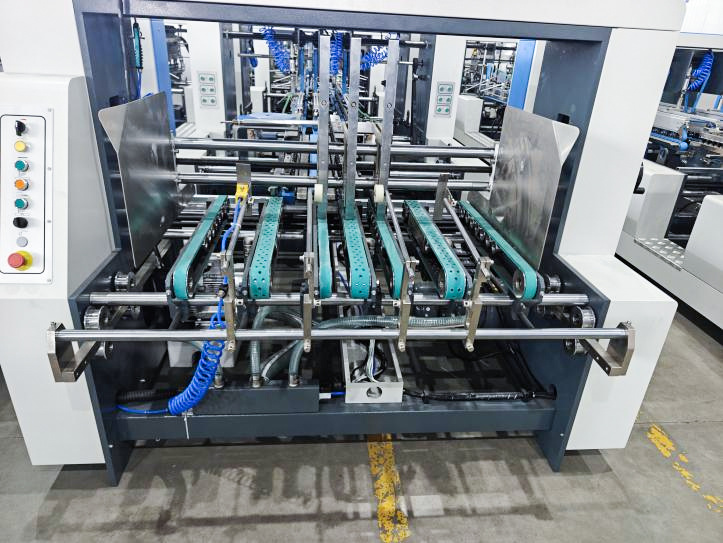
Inside packaging workshops, alignment inside Folder Gluer Equipment is closely tied to how paperboard moves through each section in real working conditions. Motion is not isolated to a single unit. Feeding, folding, pressing, and delivery all share the same moving sheet, so a small change in one section travels forward without delay.
In daily operation inside a Folder Gluer Factory, operators often notice a familiar situation. At the start of a shift, alignment appears stable. After long continuous running, edges of cartons begin to shift slightly. Folding lines move away from expected position. Glue placement looks unchanged, yet finished shapes drift.
This kind of change does not come from one failure point. It builds from small mechanical reactions that accumulate during motion.
Paperboard also plays a role. Sheets do not behave like rigid parts. They bend, recover, and react to pressure. Once movement speed increases or running time extends, sheet response becomes less uniform across the full width. That difference influences alignment from entry to output.
Small deviations appear first at guiding edges. Later, folding accuracy changes. Downstream sections receive slightly shifted material, and each stage carries that shift forward.
Mechanical Wear And Subtle Structural Shift
Wear inside Folder Gluer Equipment does not always look like damage. In many cases, surfaces still appear smooth while contact behavior has already changed. Rollers, shafts, and guide surfaces keep working, though pressure distribution slowly shifts.
In real production environments, these changes come from continuous contact rather than single impact. A roller that rotates for long periods may still move freely, yet grip consistency becomes uneven across its surface. One side may pull material slightly stronger than the other side.
Guide rails show similar behavior. Contact lines gradually lose even pressure. Material slides through with a very small directional bias. That bias does not stop production, though alignment slowly moves away from original positioning.
Common field conditions linked with wear:
- Roller surface grip changes across width during long runs
- Belt contact pressure becomes uneven after continuous motion
- Guide rail edges develop small contact imbalance
- Shaft connection develops micro looseness from vibration
- Repeated pressure cycles change stability of moving parts
In many cases, these changes are not noticed during short runs. Continuous operation makes them visible through accumulated drift in sheet position.
Feeding Behavior And Paperboard Response In Real Use
Feeding stage inside Folder Gluer Equipment deals directly with stacked paperboard. In practical use, sheets inside the same stack often show small differences. Thickness variation exists within normal range of material production. Surface coating also changes friction behavior.
Feeding rollers apply force to push sheets forward. When grip is not fully balanced, one side of sheet may move slightly earlier. That small difference becomes a starting point for later misalignment.
In workshops, this is often seen when cartons begin to show uneven edges after long continuous feeding, even though machine settings remain unchanged.
Material response also changes during continuous operation. Paperboard exposed to repeated bending along feeding path becomes more flexible. Flexibility difference appears between early and late stages of a run.
Common practical feeding influences:
- Slight thickness variation across stacked sheets
- Surface friction difference between layers in storage
- Entry angle shift during high-speed feeding cycles
- Sheet stiffness change after repeated movement
- Irregular spacing between consecutive sheets entering machine
Small entry variation does not disappear inside system. It follows sheet movement into folding and gluing stages.
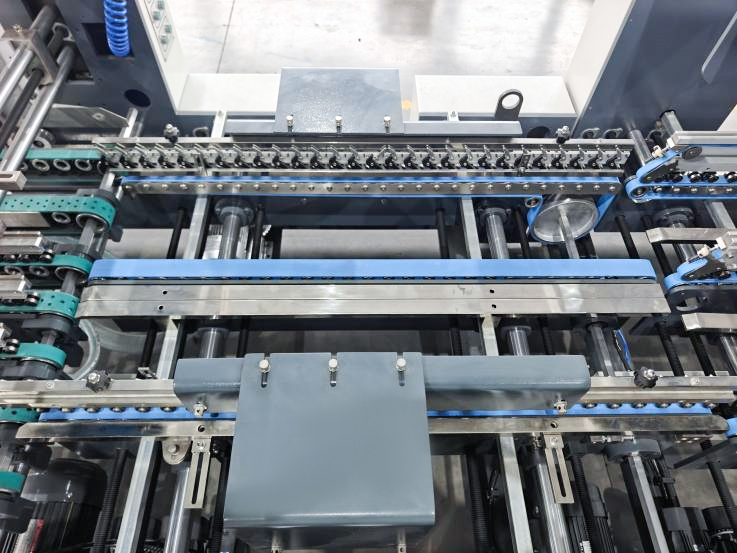
Conveyor Movement And Tracking Drift In Workshop Conditions
Conveyor belts inside Folder Gluer Equipment guide sheets between stations. In actual production, belt movement does not stay completely fixed over long running periods.
Tension changes appear gradually. Heat from continuous motion slightly alters belt behavior. Rollers supporting the belt may also lose perfect balance after extended use.
Even a small tracking shift affects sheet direction. Once belt moves slightly sideways, material follows the same path change.
In real factory observation, this often appears as cartons leaning toward one side at output stage while feeding stage still looks stable.
Common conveyor-related field behavior:
- Belt tension slowly changes across long operation cycles
- One side of belt develops slightly stronger pull force
- Roller alignment drifts due to repeated vibration exposure
- Material load shifts uneven pressure distribution across belt
- Tracking line gradually moves away from center path
This type of drift usually stays small in early stage. Continuous running allows it to accumulate across multiple production cycles.
Folding Section Pressure Difference Seen In Practice
Folding area inside Folder Gluer Equipment works with repeated pressure contact. Guide arms press paperboard into shape. Pressure balance across both sides becomes important for stable alignment.
In workshop conditions, folding imbalance often appears after long operation, not at start. One folding arm may press slightly stronger due to wear or adjustment shift. Another side may respond slower during contact.
This difference affects sheet movement during folding. Instead of clean fold path, paperboard shifts slightly before glue bonding stage.
Common practical folding influences:
- Uneven contact pressure between folding arms
- Small difference in guide rail height position
- Mechanical looseness in repeated adjustment points
- Material stiffness reacting differently under pressure
- Timing mismatch between folding contact points
In continuous production, these small differences become more visible. Carton edges start showing slight deviation even when upstream feeding remains stable.
Adhesive Application And Sheet Stability Change
Glue application inside Folder Gluer Equipment does not only connect surfaces. It also changes how sheet behaves during movement between stations.
In practical operation, glue distribution variation can create uneven stiffness on different sides of sheet. One side becomes slightly fixed earlier. Other side remains flexible for a longer time during transfer.
This difference influences alignment during movement.
Typical real-use adhesive influences:
- Glue line not fully even across entire sheet width
- Early bonding on one side before full positioning
- Moisture in adhesive affecting paperboard softness
- Delay between glue application and final contact
- Variation in absorption across different paper surfaces
Once adhesive interacts with sheet structure, movement becomes sensitive to small mechanical forces from rollers and guides.
Vibration Transmission Across Machine Frames
Inside Folder Gluer Equipment, vibration does not stay in one place during long operation. Motion from feeding rollers, folding arms, and drive parts spreads through the whole frame in a slow and steady way. The machine body behaves like a connected structure, so movement in one point often reaches other sections without much delay.
In real workshop conditions, this shows up in a very subtle form. The machine may look stable, sound normal, yet small movement still travels through support beams and mounting points. Over time, those small movements change how guide rails and rollers hold position.
Loose contact points make vibration easier to pass through. A small gap in a joint can become a path for repeated movement. Once that happens, alignment points stop holding a fixed reference for long periods.
Common field signs linked with vibration:
- Slight looseness appearing at frame connections
- Roller mounts shifting position after long running time
- Guide rails losing steady contact pressure
- Small resonance spreading across linked parts
- Repeated motion leaving tiny positional offsets
In a Folder Gluer Factory, this condition is often noticed through carton edge variation rather than visible machine shake.
Environmental Conditions Inside Production Areas
Air condition inside production spaces plays a quiet role in alignment behavior. Paperboard reacts quickly to moisture in the air. When humidity rises, sheets become softer and bend more easily. When air becomes dry, sheets turn stiffer and resist folding in a different way.
These changes do not happen all at once. They build during long operation periods. The same stack of material can behave differently after some time inside the workshop.
Temperature also affects machine parts. Metal frames expand slightly when exposed to continuous running heat. The change is small, yet enough to influence guide spacing and contact points when combined with long cycles.
Air movement inside the workshop can also disturb light sheets before full control from rollers begins. Even a weak airflow near feeding zone may cause slight entry shift.
Practical environmental influences:
- Paperboard stiffness shifting with air moisture changes
- Metal structure expanding under continuous heat exposure
- Airflow disturbing sheet entry before feeding grip stabilizes
- Material condition changing between storage and processing area
- Uneven environment across different sections of the machine line
These conditions usually work together rather than separately.
Calibration Drift And Feedback Limits
Alignment control in Folder Gluer Equipment depends on reference points and feedback signals. Over time, those reference points do not always stay in exact position. Small movement in mechanical parts and environmental influence slowly affect calibration behavior.
The change is not obvious at first. The system continues to read sheet position, yet actual sheet movement starts to differ slightly from detected values.
Correction signals still work, though response becomes less accurate when deviation grows quietly over time.
Field-related behavior often includes:
- Reference position slowly shifting after long operation
- Feedback delay between detection and correction movement
- Sensor reading affected by vibration from nearby parts
- Small mismatch between system signal and real sheet position
- Repeated correction leaving minor residual offset
In long production runs, this creates a condition where correction and actual alignment no longer match perfectly.
Load Variation During Continuous Production
Workload inside Folder Gluer Equipment changes during production without a fixed pattern. Feeding speed may vary slightly. Material thickness changes from stack to stack. Even operator adjustments during long shifts can influence load behavior.
These variations affect how force spreads across rollers and folding sections. When load increases, pressure becomes stronger and movement slightly tighter. When load drops, movement becomes lighter but less stable in direction control.
This balance shift influences alignment more than expected in continuous operation.
Common load-related field effects:
- Feeding speed change affecting timing between sections
- Uneven pressure distribution across conveyor width
- Folding section reacting differently under load variation
- Temporary instability during speed change periods
- Small shift in synchronization between connected units
Over time, repeated load changes create small differences in sheet path.
Maintenance Gaps And Small Error Build-Up
In long working cycles, small alignment changes are not always corrected immediately. Machine continues to run within acceptable range, so small offsets remain inside the system.
Each small deviation may look harmless. Over long operation time, those small offsets begin to stack together.
In real factory environments, this is often seen after long continuous runs where no major issue appears, yet final product shape slowly shifts.
Common maintenance-related situations:
- Small misalignment left uncorrected during short stops
- Minor roller adjustment not reset fully after service
- Guide position slightly different after repeated handling
- Tiny deviation passing through multiple working sections
- Gradual accumulation of small offsets across long cycles
These conditions build slowly and tend to appear in output stage rather than at early stages.
Interaction Between Multiple Working Sections
Alignment behavior inside Folder Gluer Equipment comes from interaction between several sections working at the same time. Feeding, conveyor movement, folding pressure, and adhesive application all influence sheet position in their own way.
A small change in one section does not stay isolated. It moves forward with the material. Once it reaches the next section, it combines with local variation there.
This creates a layered effect across the whole line.
Common interaction behavior:
- Feeding shift carried into conveyor movement path
- Conveyor drift affecting folding entry angle
- Folding variation influencing glue contact position
- Adhesive unevenness affecting final sheet stiffness
- Feedback correction reacting to already shifted material
The final alignment condition is often the result of all these small interactions rather than a single cause.
During long continuous running, Folder Gluer Equipment often appears stable from outside observation. Movement remains steady, sound remains even, and material flow continues without interruption.
Inside the system, small variations continue to form. Mechanical wear, material response, environmental changes, and load variation all contribute small shifts. Each one is minor alone, yet together they shape final alignment behavior.
In real production output, this appears as slight edge difference, folding position shift, or small shape inconsistency in finished cartons.
The overall behavior shows a simple pattern: alignment stability depends on balance between many small factors working together over time.
Recommended Products
Focus on providing high-quality folder-gluing equipment to customers around the world.



No.3888, Jiangnan Avenue, Nanbin Street, Ruian City, Wenzhou City, Zhejiang Province, China







Privacy Policy Copyright © Zhejiang Chengwang Intelligent Packaging Equipment Co., Ltd.
High Speed Folder Gluer Factory